
Hampden Bridge (Kangaroo Valley) “A Bridge for Eternity”
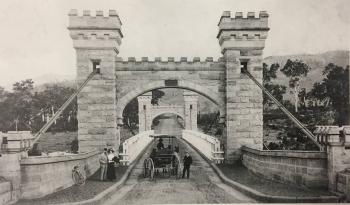
"The Hampden Bridge Report" (Updated 20 March, 2026)

Download the Full Report (222 pages/68,859 words Acrobat file, fully indexed)  free at the link below. This edition adds 20,000 words and includes a new heritage chapter that sets out how Hampden Bridge is protected under NSW Heritage legislation.

II Preface to the 16th Edition

In 2025 Transport for NSW released a draft Regional Integrated Transport Strategy (T NSW Draft Illawarra Shoalhaven, Strategic Regional Integrated Transport Plan) for public comment as part of its objective to provide:

  •  a safe road network,
  • to create a thriving and diversifying economy and
  • in order to create a resilient transport network.

It was also announced that Transport for NSW want to progress freight capacity upgrades for Hampden Bridge, Kangaroo Valley, first, by potentially progressing the immediate installation of a temporary bridge and second, by planning for a long-term solution to provide 42.5 tonne vehicle load limit on the Illawarra Highway over Kangaroo River at Kangaroo Valley. (T. NSW Draft Illawarra Shoalhaven, Strategic Regional Integrated Transport Plan)

The NSW government invited comment by February 9, 2026[1]

The first iteration of this report provided feedback to the draft regional integrated transport strategy. Over the December 25/January 26 period comments by community and regional Shoalhaven and Illawarra residents were invited through the facebook page Hampden Bridge: "A Bridge for Eternity" and through many daily discussions and consultations.  Each part of this report was released in draft form beginning with an historical account of how Hampden Bridge was built in 1898.  “A Bridge for Eternity” was released in November 2025 at this link: A Bridge for Eternity

The Report went through 12 editions, each new version entailing corrections and feedback from the community. In putting together “the report” it was expected that this process would go on ad infinitum as more and more people appreciated the elegance and importance of what de Burgh labelled simply “the bridge over the Kangaroo River”. This has proved to be the case.

This Report submitted to Transport NSW examined

  • the cost benefits of the various freight upgrade options,
  • the unique heritage of Hampden Bridge including many new historical findings,
  • the economic/social/environmental dimensions of the road system,
  • the community and population needs,
  • an evaluation of the growing and diverse Kangaroo Valley economy as well as the local and regional population pressures and needs.


The Hampden Bridge Master Report, 13th Edition, that was finally submitted in February 2026 was a detailed response to the draft transport strategy, focusing on preserving and upgrading Hampden Bridge while emphasizing heritage, sustainability, and regional connectivity.


The last Regional Transport Plan (released March 2021) outlines 71 initiatives. The view of the report was generally solid. However, it did not mention Hampden Bridge or Kangaroo Valley and this also echoed our view that the bridge has been neglected and has had little spent on its maintenance and repairs since 2011. The 2021 Transport Plan foreshadowed several initiatives that align partially with the Hampden Bridge Report recommendations (e.g., road safety, freight diversion via rail, and alternative routes like Nerriga Road). Below is a dot-point comparison, structured by key themes showing what the Hampden Bridge Report proposes for the future against what appears in the  2021 plan.


The key addition we seek in the 2026-2056 Transport Plan is for Hampden Bridge to be the sole and central crossing of the Kangaroo River, particularly at the current crossing site. This report contends that on economic, heritage, environmental and Aboriginal heritage grounds the current bridge must be repaired and enhanced to carry vehicles of 42.5 tonnes by Christmas 2027.


1. Hampden Bridge Upgrades and Preservation
 

  • Hampden Bridge Report: Proposes a phased in-situ strengthening program to restore 42.5-tonne Higher Mass Limits (HML) capacity by Christmas 2027 (Phases 1-3: stabilization, suspension reinforcement, resilience enhancements like FRP deck and seismic upgrades). It emphatically argues there should be no replacement or temporary bridge. With a BCR of 12-25:1 the repair and maintenance of the current bridge is a no brainer. The Report also suggests that the Hampden Bridge precinct could be invested in as a tourism, heritage hub and Aboriginal gateway to the South Coast with a heritage-compliant pedestrian/cycle path, and a 50-year Heritage Asset Management Plan & Maintenance Endowment (~$18M seeded fund). Transport NSW has never known or acknowledged that apart from the sites of cultural heritage to the Aboriginal community such as a “birthing cave”, the area bordering the “Pioneer Farm” was an important reserve in which one of the first attempts at “self determination” involving the creation of an Aboriginal run school and self sufficient community  was tried in 1889. (Botsman)
  • Transport NSW: In the 2021 Transport Plan there was no mention of Hampden Bridge repairs, strengthening, or replacement. The plan focused on broader road network improvements, but related items include Item 21 (Moss Vale Road, Princes Highway, and Cambewarra Road Intersection Improvements - in planning, own responsibility), which could indirectly support access around Kangaroo Valley. No mention of heritage trusts, pedestrian paths, or dedicated funding for the bridge. There was also no mention of the 2011 Repairs and Conservation Management Plan for Hampden Bridge nor its inclusion in the Heritage Register of 2019.


2. Freight Capacity and Diversion Strategies


  • The Hampden Bridge Report strongly advocates diverting heavy freight (≥45.2 tonnes) from B73/MVR271 to the Unanderra-Moss Vale rail line by 2030 (e.g., bulk commodities and livestock via Queensland's Cattle Train model), with BCR 3-4:1 and $100-200M net benefits over 20 years. It also strongly advocates completing the Nerriga Road upgrades to 42.5t HML by 2030 to divert 30-40% of east-west freight, reducing pressure on East/West mountain passes and Hampden Bridge.
  • The 2021 Transport NSW plan partially aligns with the Hampden Bridge Report. Item 71 (Moss Vale to Unanderra Line and Coniston Junction Rail Improvements - for investigation, own responsibility) supports rail enhancements for freight (and potentially passengers), echoing the Hampden Bridge Report’s rail diversion strategy. Item 36 (HPV Access for MR92 Nerriga Road between Nowra and Braidwood - for investigation, own responsibility) directly adopts the Nerriga upgrade for heavy vehicle access, which could reduce freight on Moss Vale Road and the B73/MVR271 route through Kangaroo Valley. No explicit commitment to full freight diversion timelines or livestock-specific models.


3.Road Safety and Reliability in Kangaroo Valley Region


  • The Hampden Bridge Report particularly highlights the concept of “sustainable roads” following the bushfires of floods from 2018-2020 and the extremely high cost of repairs to mountain passes (Barrengarry vs. Cambewarra vs. Macquarie Pass), risks from floods/landslips. As a preventive measure it emphasises the reinstatement of permanent maintenance teams to be based in Kangaroo Valley. It recommends Illawarra Highway/Macquarie Pass safety tech (e.g., for heavy vehicles) and an ongoing focus on B73/MVR271 resilience. The Report emphasises that the Moss Vale road through Kangaroo Valley should not be considered a 21st century through freight route and must be re-conceptualised as primarily a tourist gateway both to Kangaroo Valley and the South Coast.
  • The 2021 Transport NSW plan addresses regional road safety broadly—Item 40 (Illawarra Highway Safety and Reliability Improvements - for investigation, own responsibility) this aligns with concerns about the durability of Macquarie Pass and the Barrengarry Mountain and Cambewarra Mountain passes through Kangaroo Valley. Item 38 (Identify opportunities for technology to improve heavy vehicle safety on Macquarie Pass - for investigation, own responsibility) specifically matches the Hampden Bridge Report’s emphasis on tech-driven solutions. Item 34 (Establish guidance for roadside vegetation management to improve bushfire resilience - for investigation, own responsibility) supports resilience against natural disasters, similar to the Hampden Bridge emphasis on sustainable roads following flood/bushfire crisis. However disappointingly over this period permanent maintenance teams disappeared from Kangaroo Valley replaced by crisis management contract project teams dealing with mountain slips and road repairs on both Barrengarry and Cambewarra Mountain passes.


4.Heritage, Economic, and Community Impacts


  • The Hampden Bridge Report places emphasis on Hampden Bridge's heritage protections (State Heritage Register #01469), economic benefits (e.g., tourism, jobs from upgrades—44-55 FTE across phases), and community needs (e.g., no closures, pedestrian/cycle path with 92% support). The Conservation Management Plan (CMP) for Hampden Bridge, probably developed for the 2011 Hampden Bridge repairs, is not a public document and cannot be readily found. It is referenced in the Heritage Register but does not appear on either the Heritage Council or Transport NSW websites. It is critically important that this document be revived and considered by the Kangaroo Valley and general community to create trust, to prevent neglect and to ensure that any future strategy is integrated with regional economic needs (e.g., dairy, tourism).


  • The 2021 Transport NSW plan does not mention any direct Hampden Bridge heritage or bridge-specific economic initiatives. This is one of its major flaws and must be addressed in the future 2026-2056 Regional Transport plan. Item 62 of the 2021 Transport Plan (Work with Local Government, DPIE, and industry to ensure regionally significant growth areas support walking and cycle-friendly neighbourhoods - for investigation, collaborate) could support the case for a pedestrian/cycle path for Hampden Bridge indirectly. Similary Item 67 (Work with NSW Department of Education, Catholic Schools NSW, and Local Government to address barriers to walking and cycling to school - for investigation, collaborate) could promote greater bicycling tracks and active walkways for Kangaroo Valley. Tourism/economic growth is mentioned in the vision (e.g., productive theme), but not tied to Hampden Bridge. This once again is a flaw of the past plan.


5. Sustainability and Low-Emissions Transition


  • The Hampden Bridge Report supports regional shift to low-emissions (e.g., EV parity by 2024), rail for sustainability, and resilience packages (e.g., scour protection, dampers) for 100+ year bridge life.


  • The 2021 Transport NSW plan has a strong focus on sustainability—Item 25 (Work with DPIE, DRNSW, and industry to develop an EV Fast Charging Network - in planning, collaborate) and Item 61 (Work with DPIE, DRNSW, and industry to develop a hydrogen refuelling station network for heavy vehicles - for investigation, collaborate). This aligns with the Hampden Bridge Report’s low-emissions push. Item 54 (Transition Transport for NSW passenger fleet to 70% low emission and 20% battery electric or hydrogen by 2025 - for investigation, own) and Item 55 (Transition bus fleet to 100% zero emission - for investigation, own) support fleet transitions and rail improvements (Item 71) to aid sustainable freight which also complements the Hampden Bridge Reports findings and recommendations.


Overall Observations


  • Adopted Elements: The 2021 Illawarra Shoalhaven Transport plan includes some of the Hampden Bridge Report’s  broader recommendations (e.g., rail upgrades, Nerriga diversion, safety tech on passes), with a focus on regional freight and resilience strategies. It does not mention a temporary bridge or full replacement and it seems these have emerged independently of the 2025 draft plan.


  • The omitted elements: Any mention of Hampden Bridge (e.g., strengthening to 42.5t, heritage trust) is absent.


  • The 2021 Transport NSW plan prioritizes investigations within 10 years, Items 21, 36, 40, 71 are effectively addressed by the  Hampden Bridge Report.


On all grounds, including cost benefits, the overwhelming evidence presented to Transport NSW is that Hampden Bridge should be maintained as the central and only bridge over the Kangaroo River (certainly at the original Moss Vale crossing site) with a 42.5 tonnes weight capacity. To guarantee the viability of this strategy, it is argued that a heritage and maintenance trust for Hampden Bridge should be established. This would guarantee Hampden Bridge as the most appropriate and sustainable working centre of the MVR271/B73 road system for another 127 years.[2]

In this edition of the Hampden Bridge Report we have added a chapter on the heritage protections which we have grown to understand better since first beginning to research Hampden Bridge. Hampden Bridge is protected by its listing as one of the highest priority NSW Heritage items. This listing occurred in 2019. It creates an important framework for the Kangaroo Valley and larger NSW community to understand Hampden Bridge’s unique place in our history. It also creates a foundation stone for the community to draw from and improve over coming decades. It certainly must be addressed in the forthcoming Illawarra and Shoalhaven Transport Plan.

In the lead up to the new Transport NSW plan the Hampden Bridge Report will be updated regularly as we incorporate new information and subject the report to expert reviews.

In the short term (March–September 2026): Friends of Hampden
Bridge will:

  • Focus on Track Item 21 (Moss Vale Road, Princes Highway, and Cambewarra Road Intersection Improvements). Hampden Bridge is on Moss Vale Road so this ties into broader route resilience (e.g., flood/landslip risks). TfNSW's website (transport.nsw.gov.au) and project newsletters are actively monitored.
  • The Hampden Bridge Report addresses Item 36 (HPV Access for MR92 Nerriga Road between Nowra and Braidwood – for investigation, "own"). The Report argues that 30-40% of east-west freight could be diverted from B73/Moss Vale Road, reducing bridge pressure—aligning with rail/freight diversion ideas.
  • The Hampden Bridge Report addresses Item 38 (Opportunities for technology to improve heavy vehicle safety and Item 40 (Illawarra Highway Safety and Reliability Improvements – for investigation).  It is argued these must extend to Barrengarry and Cambewarra passes supporting “sustainable roads”. It should be noted that a majority of Kangaroo Valley Village residents are supportive and thankful for the 23 tonne limit on Hampden Bridge which has been in operation for most of 2025 and continues into 2026.
  • The Hampden Bridge Report prioritises Item 71 (Moss Vale to Unanderra Line and Coniston Junction Rail Improvements – for investigation, "own"). The Hampden Bridge Report directly supports Unanderra-Moss Vale rail freight diversion proposal (e.g., for bulk/livestock). And FOHB will continue to review ARTC's (Australian Rail Track Corporation) updates, as they manage the line and link up with other initiatives to improve the South Coast Rail corridors.
  • The Friends of Hampden Bridge continue to address TfNSW directly through reference group meetings and other meetings.
  • This edition of the Hampden Bridge Report includes an additional chapter highlighting Hampden Bridge's State Heritage Register status (#01469) and how it aligns with the plan's resilience objectives (e.g., Objective 3 on technology for network resilience, page 58).
  • FOHB will continue to work with expert engineers to provide the best possible community understanding of bridge repairs and maintenance undertaken through Transport NSW.

Medium-Term Steps (October 2026–September 2027): Advocate During Investigations

  • The Friends of Hampden Bridge are continuing to engage with Transport NSW and other bodies over the medium to long term.  This includes monitoring the updated Illawarra Shoalhaven Transport Plan to be released in 2026. This will include advocating for:
    • The extension of 2021 Report’s Item 71's rail study to include far greater freight diversion modeling (e.g., adapting Queensland's Cattle Train for livestock), calculating BCRs from report (3-4:1 over 20 years).
    • Item 40's Illawarra Highway review, advocate extending safety tech (e.g., AI cameras, sensors) to Moss Vale Road, including moving forward bridge monitoring (IoT sensors for Hampden Bridge Phases 1-3).
    • Link to broader sustainability: Tie into Items 54-55 (fleet transitions to low-emissions) including the creation of EV charging stations at the Hampden bridge precinct
  • Secure Funding and Partnerships: Apply for grants under Federal Active Travel programs (e.g., for pedestrian/cycle path) or NSW Heritage grants for proposed maintenance endowment (~$18M). Collaborate with DPIE (Department of Planning and Environment) on Items 59-60 (SIC-funded infrastructure for growth areas), arguing Kangaroo Valley's tourism/economic role.
  • Media and Public Campaign: Highlight positive aspects of Hampden Bridge for the Kangaroo Valley and regional economy, sharing visuals from this report (e.g., historical photos of Hampden Bridge). Aim for pro Hampden Bridge op-eds tying the bridge to the Regional plan's vision goals (e.g., 20% active/public transport trips by 2041, page 4). Also start to begin work on the idea of an Aboriginal gateway to Kangaroo Valley and the South Coast through the Hampden Bridge precinct.
  • Assess TfNSW's 2026 Repair Works: By late 2026, evaluate the beam/hanger replacements lobby for expansion into full strengthening (Phases 1-3), using the plan's "adaptive and sustainable" theme. This involves engaging with a group of consultative engineers willing to support Hampden Bridge as a long  term and important transport initiative.

Long-Term Steps (October 2027 Onward): Push for Plan Updates and Resilience

  • Influence Future Reviews: The 2021 plan was a "blueprint" under Future Transport 2056, with potential updates every 5-10 years. The Hampden Bridge Report is effectively a future blueprint with community support (92% for pedestrian path) and economic benefits (e.g., tourism jobs from your report). Continually revise the Hampden Bridge Report with more information.
  • Build Regional Alliances: Partner with groups in Nowra-Bomaderry or Shellharbour (e.g., via Items 1, 29) to advocate for interconnected upgrades, including rail (Item 47: Maldon-Dombarton) as a complement to Unanderra-Moss Vale and more improvements of the South Coast line but also incorporating the Bomaderry/Wollongong line to Moss Vale as a way of accessing southern and western passenger railway routes.
  • Monitor Outcomes and Adapt: Track BCRs and progress via annual TfNSW reports. If items stall, escalate to the Minister for Regional Roads or initiate a community inquiries and polls, referencing the plan's commitment to proactive delivery.
  • Sustain Heritage Focus: Establish a local trust or CMP (Conservation Management Plan) independently if needed, using the Hampden Bridge report's framework to ensure the bridge's "eternity" aligns with the plan's low-emissions future (e.g., EV/hydrogen networks, Items 25, 61). This is one of the major reasons to upgrade the Hampden Bridge Conservation Management plan last updated in 2011?

This 16th edition also incorporates for the first time comments by an expert group who have kindly offered to review the recommendations we have put forward for repairs and strengthening of Hampden Bridge. Their full commentary appears on p213 as Appendix 21 Engineering Comments on the Hampden Bridge Report (8 February 2026). In addition several tables and costings have been adjusted to take into account these welcome and constructive ideas and suggestions. There is much more work to be done on these aspects of Hampden Bridge and we are grateful to Engineers Australia and the engineering faculty at University of Technology (Sydney) who have some familiarity with the Hampden Bridge and its ongoing place as a valuable engineering icon and functioning transport mechanism relevant to 21st century community and vehicular needs.

Hampden Bridge Group of Researchers and Supporters

March 19, 2026


[1] Community members can view the draft Plan and provide comment until Monday, 9 February 2026 at www.haveyoursay.nsw.gov.au/sritp/illawarra-shoalhaven

[2] All calculations of costs and benefits in this report were best estimates based on benchmarks, standard government infrastructure calculations and recommendations, past projects, public statements by NSW Government departments, Federal government departments, Shoalhaven City Council and other public instrumentalities. The report recognises that costs and estimates are subject to an infinite number of variables and interpretations. In presenting current, future and historical costs the aim is to create a starting point that can empower community members to start a dialogue that will enable them to question and compare the costs of different options and to more exactly examine presentations by public authorities. In this regard all dialogue with professional engineers, actuaries and government representatives is welcomed.

Downloadable files: