
Gatirri School: A Teacher who Lives There
Gatirri School at Mata Mata grew from the teaching of Mrs P.B. Burarrwaŋa, one of the first fully trained Yolŋu teachers.
Gatirri School is the community name of the Matamata Homeland Learning Centre, the school at Mata Mata, a Yolŋu homeland on the Arafura coast of north-east Arnhem Land. It is named after Gatirri Burarrwaŋa, who founded Mata Mata and was head of the clan. It grew from the teaching of his daughter, Mrs P.B. Burarrwaŋa, one of the first fully trained Yolŋu teachers, an outstanding leader and a pioneer of Mata Mata and the homelands movement. She taught children in the bush and under a tree long before there was a school building.
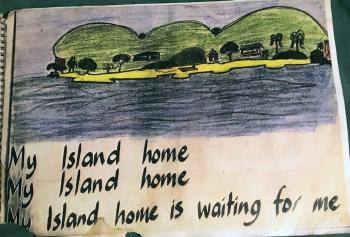
The building went up in 1987 and has now been fully refurbished. The school has never closed, and its children are enrolled through Shepherdson College at Galiwin'ku. In about 1995 the Gatirri School children illustrated their own book of My Island Home, and the paper tells that Mata Mata story too.
What Mata Mata has asked for since at least 1978, and still asks for, is a teacher who lives there. The usual homeland arrangement is a Yolŋu homeland teacher every day, with visiting teachers who fly or drive in for part of the week. The paper sets out the real strengths of that model, which is run well at Laynhapuy. But a resident teacher is there when the plane does not come, and works alongside Dhambiŋ and the other Yolŋu teachers every day, not twice a week.
The paper puts forward the community's aspiration: a seven-day teacher, living at Mata Mata through the week and the weekend, ideally a Yolŋu teacher, trained and qualified and teaching on their own country. With that teacher, Gatirri could become a real primary school in its own right, and also a secondary school and an adult learning school: a school for lifelong learning at Mata Mata. In a sense Mata Mata already is one: Yolŋu culture is learned there every day of the week, on country, from elders and family. A seven-day teacher and formal schooling would build on that, not start from nothing.
The paper argues that a resident teacher is what would let Gatirri School anchor a self-sustaining homeland with a good income. A school brings jobs, among them homeland teachers teaching Yolŋu knowledge, and cleaning and maintenance work. Jobs and families bring a shop, and a school and a shop bring people home to live, as Mäpuru shows.
Drawing on O'Bryan and colleagues (2025), the paper shows how homeland learning centres miss out on the recurrent funding and grants that small schools receive, which leaves homeland education "in a vulnerable state". It compares Gatirri with Laynhapuy, Shepherdson College's homeland centres, Mäpuru, Baniyala, the Milingimbi, Ramingining and Gapuwiyak hubs, the Homeland School Company at Maningrida, Nawarddeken Academy and Dhupuma Barker, and lists the schools of the region in an appendix.
Its first recommendation is simple: a qualified teacher living at Mata Mata seven days a week, ideally a Yolŋu teacher, housed and supported, working with Dhambiŋ and the Yolŋu homeland teachers within the Shepherdson College network. It also calls for proper pay, training and housing for the Yolŋu teachers who carry the school every day.
This is a first full draft and will be updated as new information comes to hand. Where the record is thin, it says so.
Support Mata Mata through the Indigenous Stock Exchange (ISX) campaign: https://www.isx.org.au/projects/mata-mata-homelands
Downloadable files: